Beginning the Countdown, er, Journey

Part 1: Looking Ahead to a New Phase in Life

By Patty Pearsall

I have reached that stage in my life where the end is in sight.  Well, at least the end of working full time is in sight.  I actually thought (hoped) it would be this year, but a hitch with service months has pushed it back another year.

Although I have not yet achieved the typical retirement age, I feel ready to move on.

Seriously, I need to retire from full time working just to accommodate my personal life!  My current life is definitely different (busier and more fulfilling) than when I began working.   I don’t mind working and am grateful that I have a job and great coworkers–and most of the time wonderful patrons–but I confess that I am ready to ease back on the work schedule.  I am ready for that long vacation.  I admit I am looking forward to “Every day is a Saturday” syndrome, as one of my retired friends likes to joke.

I am also at the stage of life where some of my colleagues and friends are retiring.  I feel like the youngest child who sees her sibling doing all these enviable things because they are older. 

Then there are those dratted and wonderful technologies, software, and material formats that seem to be changing or springing up every week.  I can grasp some of it, but am amazed at how our Digital Technology Librarian soaks it up, or can watch educational videos and seem to easily understand the technique or concept.  I like to learn new things, but some days it feels like my brain just can’t comprehend this stuff.

This may seem strange, but Algonquin Area Public Library District was my first professional workplace after graduating from Library School, which I had attended immediately after receiving my undergraduate degree, and here I have been ever since.  During 30+ years, I have worked in various positions and several departments. 

I will not fool myself into thinking that it was only yesterday I was beginning my career at the Library; however, I do admit that it doesn’t seem all that long ago that we moved into the current Library building and it has actually been 19 years! 

Some of my friends tease me and ask if I can recount the number of days/hours until leaving but I have no interest in doing that math.  I admit that last year I did sometimes think, “Oh, this is probably my last time doing this,” but I have not mentally trotted out that phrase after having to readjust my time schedule. 

So, here I go, moving towards another next phase in my life.  The time will go fast, my friends assure me.  And it will probably will, or at least continue to march forward.  In the meantime there are still desk shifts to work, book groups to lead, books for those groups to choose, materials to order for Library collections, materials on the shelves to review, technology to learn and remember, and, well, whatever else comes along.

Four Steps to Greener Purchasing

By Laura L. Barnes

In my last post, I wrote about ways to make your building more efficient and save money. This time, I want to focus on other purchasing decisions you make when you buy supplies for your library. Rethinking your purchasing can reduce your costs, help to create markets for products made with recycled material, and reduce the use of toxics in your building.

  1. Include environmental factors as well as traditional price and performance considerations part of the normal purchasing process. Planning ahead can reduce your waste disposal costs and use of hazardous chemicals, improve employee health and safety, and reduce material and energy consumption. Develop a green purchasing plan. CalRecycle has a list of examples and NASPO’s Green Purchasing Guide has detailed instructions for developing a green purchasing program.
  2. Emphasize pollution prevention early in the purchasing process. Review purchase specifications and contracts to see if they contain environmental performance standards or requirements. For example, if you use a cleaning service, request that they switch to less hazardous cleaning supplies. The Green Libraries LibGuide has a list of green product guides and certification bodies. Purchase appropriately sized lots to minimize waste. Purchase in bulk where feasible, but small quantities for shelf life/dated materials.
  3. Examine multiple environmental attributes throughout a product’s life cycle and compare relative environmental impacts of different products. Think about the environmental impact of the product’s production, use, and disposal. Buy recycled office consumable products (paper, pens, etc.) and Energy Star certified office equipment. Consider buying reusable utensils, plates, and cups for meetings. Rethink your promotional items.
  4. Base purchasing decisions on accurate and meaningful information about environmental performance. Don’t fall for greenwashing. Make sure that environmental claims about products are specific. Look for specific amounts (recycled content, a certain percentage less packaging). Terms like “eco-friendly” and “environmentally friendly” don’t mean anything unless they also provide more specific information. Degradable products don’t save landfill space. It does matter if you’re composting, but not if you’re throwing them away after one use. Look for green labels like EPA’s Safer Choice, EnergyStar, EPEAT (for electronics), and WaterSense. Use product guides to help you make decisions.

Work with your current suppliers to locate more environmentally friendly products. Test the products over a few months to assess efficiency, quality, and user friendliness. Document what does and doesn’t work, so you can continue to improve. Finally, encourage your patrons to start thinking about what they buy. Create displays about the environmental impact of consumer culture. The Green Libraries LibGuide includes a list of books about the environmental impact of consumer behavior. Screen The Story of Stuff and lead a discussion afterwards. You can not only make an impact on what your library purchases but also how your community thinks about consumption.

Trials and Tribulations of a Hometown Librarian: Part 1

By Shannon Kazmierczak

In a series of posts beginning with this one, I’m going to offer up a few examples of the amazing things about living in the community where you work, as well as some of the challenges.

Part 1 – The Concierge Librarian

So, no one ever told me that becoming a librarian meant also automatically becoming your friends’ and families’ personal librarian. Add this to living in the town where you work, and there’s a whole new level to providing exemplary customer service. I have decided to now refer to myself as a “concierge librarian.” It sounds so fancy!

The role started out small, simple–empowering, even.

“Hey! What are you reading right now?” or “What should I read next?”: These are flattering requests when coming from patrons, but mean so much more from loved ones. These people value your opinions! In their minds, since you are apparently involved in this secret cult of people who “know” books, you, of course, have the inside scoop. Share your knowledge; sprinkle that stuff around! I even took this as an opportunity to teach them some library lingo. I would introduce them to NovelList or Goodreads. I would tell them the next book I was reading for book club was fantastic, hoping to garner some interest in attending the club! (It’s at a wine bar, I hear people like wine!)

Then the expectations increased a bit:

“Are you heading into work this evening, could you possibly drop off my books?”

Sure, of course, why should they have to go out of their way to do that?

Then there would be the occasional request to pick up their hold, or place something on hold:

Easily done, I had to pick up my own hold! Place a hold? Sheesh, I do that a dozen times a day–what’s one more?

Then I realized that people may think that librarians really are superheroes:

“Hey can you grab me a copy of (insert name of book with 1000 holds on it at the time here).”

Oh jeez I wish I could, but I placed a hold for that one myself when I saw it listed in Publisher’s Weekly. I’m still waiting for it!

Then things got a little out of hand:

I (over) volunteer for my kids’ schools. The principal of the grade school (who is amazing) had the great idea to begin book clubs during the months with inclement weather twice a year during lunch and lunch recess. She had parents, teachers, administrators and support staff heading the discussions for the groups. They loved the opportunity they were given. The kids loved this idea, too. They loved it so much, in fact , that 214 third through fifth graders signed up for the book clubs.

How do I know that number, you ask?

Well, since I work at the public library in the town where I live, and obviously have a library card there (and was the PTA president), the principal asked me to check out all 214 books out on my card.

(Sidenote: this is also how I found out how many items you could check out on one library card, because the circulation manager had to override the checkout process fourteen times. So, the next time someone asked me how many books they could check out, I gave them an emphatic “200!” They sort of just looked at me, bewildered at my enthusiasm.)

Yikes.

Okay, we can do this! We will make a plan!

We worked with the youth services outreach librarian. She placed the holds for 7 copies each of the 30 or so different titles, and as they came in, they started accumulating on my “items checked out” list, as did my anxiety.

It’s okay, we have a plan!

Each book has its own barcode, right? So, I printed out a list of my checkouts and gave them to the secretary at the school office who would write down the student ID and barcode on a sticky note on the inside of each book and next to the checked out item. This ensured that each student received the correct book and that all books were accounted for! Success!

We planned for everything!

Except for when all 214 books had to somehow get from the library to the school, and then from the school back to the library.

I knew at that moment that all the bags that my husband makes fun of me for holding onto would come in handy, and that purchasing an SUV was truly a good idea!

The books were hauled bag by bag across the street and up the very long walkway to the entrance to the school. I took as many as I could carry at once. It was a success! The kids got the books, the books were read, the kids loved them, and by some miracle every single book was returned and removed from my library card at the end of the 6 weeks of the program!

We did this all over again the next year too. Then one day, I found out that a certain discount department store’s bag that is sold at the checkout aisle was not meant to hold 25 copies of Raina Telgemeier’s series of graphic novels. Nor was it meant to sustain the weight of Harry Potter and the Prisoner of Azkaban, or neither for that matter the large quantities of Diary of a Wimpy Kid: The Meltdown. There those treasures were: all over that very long walkway, the curb, and maybe even a few in the street.

Long story short: I now ask the maintenance man to deliver the books, and my concierge librarian duties are held to the aforementioned roles established prior to the Great Book Club Debacle of winter 2018.


The Importance of Stories When Measuring Success

By Sarah Keister Armstrong

When you speak to someone about why libraries are important, when you interact with your state legislators, or when you explain (again) why libraries are still relevant in the age of Google, do you lead with your library’s circulation numbers? The number of times staff answered reference questions? The number of visits to the library’s website?

Whether it’s to show the progress you have made towards the goals in your strategic plan, a monthly board report, or an annual compilation of usage statistics, libraries are collecting and analyzing data all the time. But what are we measuring? Does it matter? Why are we spending all of this time quantifying metrics? Does it help us reach our goal of effectively measuring our success?

When we talk about measuring success, it’s easy to conflate “outputs” and “outcomes.” But if we look beyond the quantitative outputs with which the library world is so accustomed – circulation, patron counts, program attendance – we can explore how to better measure and communicate the true impact our services and resources have.

Outputs are quantifiable indicators that measure activity. How many people walked in your doors this week? How many programs did your library hold? How many people did you reach at an off-site event?

An outcome tells us more of a story. Has knowledge changed as a result of our work? Has actual behavior changed? Has our work resulted in actionable, meaningful change in someone’s life?

Outputs are easily and clearly communicated with numerical data, and while tracking these measures of your library’s success is important, we must push beyond reporting what we’re doing to tell the story of why we’re doing it.

This is where stories come in.

We all have anecdotes about the impact our libraries have on the lives of those we serve. I often cite an example of an individual who participated in a focus group I facilitated:

After struggling with reading ability for many frustrating years, the library helped her improve her literacy and confidence as a reader. With the encouragement of a library staff member, she worked up the courage to check out an adult nonfiction book. For the first time in her life, she finished the book, cover to cover, and went back to the library to check out five more.

Measured in terms of outputs, this user’s experience totaled six circulations. Is that valuable information to have? Yes, it’s important to be aware of our operational activity. But the outcome of this library’s work – the interaction with staff, the readers’ advisory services, and the ease of locating materials – was that it transformed an adult into a confident reader (and a lifelong learner and library user).

Libraries have historically excelled at measuring and sharing their outputs, but pinpointing a feasible way to measure outcomes can be a bit more daunting. We need context, stories, and depth behind the numbers with which we are all so accustomed. The golden combination of valid and reliable quantitative data supported by illustrative anecdotes and demonstrated impact is a much more persuasive way to express the value of your library than a monthly report of isolated statistics.

How this combination takes shape will be different for every library. While there is value in having standardized outcomes across an industry—portraying the collective impact libraries have and demonstrating concrete and economic value—the unique roles libraries play within the communities and constituencies they serve necessitate a degree of individuality when it comes to measuring impact. One way to start is simply by reflecting on what you see when users walk through your doors. Do you see numbers, or do you see people, coming to enrich their lives through what the library has to offer? Yes, we’re in the information business, but we’re also in the people business, and that’s fertile ground from which to start communicating the true narratives of our organizations

The Most Ridiculous Thing Anyone Has Ever Said To Me At Work

By Shannon Kazmierczak

“That’s not a real book”: or, the most ridiculous thing anyone has ever said to me while working on the desk.

When most of your hours are spent at a public facing desk, you tend to entertain a good amount of questions and requests that come off as mildly offensive (you’re replaying some of your own in your mind right now, aren’t you?).  Some of these questions and requests will be microaggressions that you may let slide because of the patron’s age or experience (or lack thereof). Others are backhanded comments asking things like, “Do you read all day?” That one never gets old, does it?

Yet, has anyone ever said anything so disarming to you at work that you are rendered speechless? 

While working the desk one morning, a patron asked me for an uncommon Isaac Asimov novel. We didn’t have it available nor did many nearby libraries, but it was available on Hoopla. These are moments as my library’s Digital Downloads Coordinator that I get a little giddy! What is more satisfying than being able to give someone the instant gratification of a book through a platform that allows you to have simultaneous use of eBooks and audiobooks (see why I write to the audience that I do?)? Unfortunately, my dear patron didn’t have the same enthusiasm that I did. Their response?:

“I want the book.”

But don’t you see? This is the book! And it can be in your hot little hands, at no cost to you, in a matter of seconds–on the chance that you remember your PIN.

“That’s not a real book.”

Maybe they misunderstood me.  No, this is the book; these are the writings of Sir Isaac Asimov himself, containing all of his ingenious ideas that make him the master of SciFi.

“I want the book,” they say again.

I’ve dealt with these types before–maybe they’re a bit of a luddite, someone who waxes poetic about the weight and feel and smell of a book. I’m a librarian, I get that. 

“I assure you,” I tell them, “this book is the real book. It’s the exact book you are asking for in the format that we can get to you right now.”

Then the patron said it; I’ll never forget. The moment the words left their lips I was devastated.

“eBooks aren’t real books–they aren’t books at all. In fact, this is just another computer.”

I wanted to shout, “Take it back, take those words back!”  Maybe I did, I can’t remember. I sort of blacked out for a moment. It was my instinct to argue, but I played it cool. I turned into a library salesperson, almost akin to “What can I do to get you into this book today?”

I told the patron that they should give it a try: “It’s so lightweight and carefree, and you could have been halfway through it by now if you weren’t busy telling me such nonsense!” Yet, they continued with the rationale that unless the text was something one could hold in their hands, “as the author intended”, then it’s just not a book.

That was the last straw.

I showed my librarian side then and there, and told them all of the reasons that this eBook was still a book! I argued that ebooks help people who have dyslexia, and that these books provide access to texts that have long been out of print and can’t be purchased readily in physical form by the public library. These books save trees by not being printed on paper, and these books, that also come in audio form, allow people who experience vision problems to read via increased font sizes or by listening to it read aloud to them. Are you telling me that blind people aren’t reading?

Okay, maybe I took it a step too far, but the patron still wasn’t convinced. My fight was over. Exhausted and defeated, I told them that there was only one other copy of this book in the system in print and that the owning library was over an hour away. I offered to place a hold on it for them, and said that the book would be available within a week.  The response?

“So you don’t have it right now?”

Six Steps to a More Efficient Building

By Laura Barnes

Libraries are expensive to operate and there is never enough money to go around. By looking for opportunities to make your building more energy efficient, you can make changes that will continue to save you money for years. These six steps will help you start to improve the energy performance of your building, as well as save money that you can use in other operational areas.

  1. Establish a baseline and assess your current energy use. Before you make changes, you need to understand where you are. Become familiar with your electricity and natural gas bills. Understand how much energy you use each year and how much it costs you. Quantify specific energy uses and costs. Some areas to look at include:
    1. Lighting – Are you lighting areas that people don’t use? Are there places where you can replace less efficient lighting with LEDs or compact fluorescent bulbs? Do you have decorative lighting? Are your exit signs LED? Are lights too bright for the space?
    1. HVAC – Do you have programmable thermostats? Are they programmed appropriately for your hours of operation? How old is your HVAC system? Has it ever been recommissioned/retro commissioned?
    1. Building envelope – Does your building have leaks around windows and doors? Is your building’s insulation adequate for the climate? Are your walls uninsulated brick or block?
  2. Get technical assistance. Ameren and ComEd offer free energy assessments for public sector agencies. The University of Illinois’ Smart Energy Design Assistance Center (SEDAC) offers free public sector energy assessments, assistance with retro commissioning, and information on how to save energy.
  3. Make a list of changes you want to make, then prioritize it. Some examples of first priority changes include: installing motion sensors, turning off lights when not in use, eliminating decorative only lighting, installing LED exit signs, adjusting your programmable thermostat to align with building occupancy, installing weather stripping and sealing cracks, and checking your building’s hot water temperature and resetting, if appropriate.
  4. Plan for more expensive changes and look for incentives to help you pay for them. These include installing dimmable switches and occupancy sensors, addressing over-illumination, converting to more energy efficient lighting, recommissioning or retro commissioning your HVAC system, upgrading to high efficiency equipment (boilers, fan motors, furnace), replace broken or malfunctioning windows and doors with those of higher performance, replace your roof and install more insulation, find creative solutions for uninsulated brick or block walls, and install a high efficiency water heater.
    1. Ameren and ComEd offer public sector energy efficiency incentives. SEDAC will also help you find qualifying incentives.
  5. Continue tracking your building’s energy use and making changes to ensure continuous improvement.
  6. Tell your patrons. Let them know how much of their money you’re saving with the changes you make and how you’re using those funds to benefit them.

Building remodels or new construction are usually when libraries look at energy efficiency options. Why wait when you can start saving money now?

Creating Displays that Engage and Delight

By Susan Dennison

Displays: they can either be delightful or drudgery, depending on how you see them. We pile books on tables based on who recently died, current events, hot reads and other clever categories that staff invent. And these types of displays work – many readers have discovered a new author or book here.

But what if our goal for displays was to engage our visitors, to delight them with the unexpected?

Here’s how we did it.

A young member gets her picture taken with Bernard the Card.

Bernard the Card

At Indian Trails Library we launched our first “dynamic” display with our own creation: Bernard the Card. Crafted of foam core, Styrofoam, acrylic paint and children’s clothing, Bernard was designed to greet people when they entered the library. He quickly became a favorite of children who wanted to hug him. He’s been thematically dressed for our gardening program and Halloween.

One Book, One Community

For our One Book, One Community (OBOC) program, we created a diorama with features from Jamie Ford’s Love and Other Consolation Prizes. It encouraged our members to see the novel in a different way and get them excited about OBOC programs and the author visit.

Sometimes things disappear on displays, so we learned how to protect them.

Women’s History Month

Women’s History: One of our most popular displays.

This display was a feast for the eyes, with art and props acquired from craft stores and Etsy and made in our makerspace. By promoting a theme for the month, we drew attention to the many programs and resources we had on women’s history.

Summer Reading

Mark E. was our display for our summer library adventure – ILA’s iREAD “It’s Showtime at Your Library.” We modified our logo to become Mark E., the ticket taker at the show. This display generated awareness of the summer reading program.

Farmer’s Market

Farmer’s Market: Aleksandra Terlik (L) and David Wright are the creative team behind our displays.

Our most expensive display to date, as we purchased the stand, which we will repurpose for other displays. This display was also a learning experience as the fruit was so realistic, children tried to eat it. We ended up putting resin over every loose berry and leaf and moving the display upstairs to the adult section.

If you want to challenge yourself to create these types of displays, here’s what we learned.

  1. Time
    It takes more time than you might expect to create a display. Staff need uninterrupted time to design, prep and assemble the display. Each display takes about a week to complete.
  2. Passion and creativity
    I haven’t contributed anything to the displays, other than, “Looks awesome!” because the desire and creativity to build them are not my strengths. Luckily, I have staff who love this kind of work. If you assign this to a staff member, make sure it is something they care about.
  3. Money
    Most of our displays average around $50 in cost, which isn’t too expensive. We try to reuse as much as we can from previous displays. We showcase 10-12 displays a year.
  4. Destruction and Protection
    By the time Bernard the Card was removed from the lobby, he was in desperate need of care. His “back” was breaking; his gloves had chocolate on them and his arms were coming off. He was very well-loved, but not meant for the handling he received.  When we installed the One Book, One Community display, we quickly learned that many of our miniatures were disappearing. We purchased a 5-sided 20” by 20″ cube to cover the display.
  5. Consistency
    We change the displays about once a month or so and except for the Farmer’s Market, we keep them in the same place. If there are delicate parts to the display, it is built to fit our protective cube.

Seeing people stop and look at the displays or receiving a comment from a member about a display makes me smile. I know the work staff has put in to create these moments of magic for the library and knowing our members are enjoying these displays makes it all worthwhile.

Shining a Light in the Darkness: Celebrating Banned Books Week

By Donna Forbis

Each year, the last week in September is designated as “Banned Books Week,” a time to reflect on the history of censorship and a time to actively fight those who would stymie the free flow of information in today’s world.  As librarians, we sometimes have a love/hate relationship with Banned Books Week.  Our hearts want us to shout from the rooftops, “Everyone should read these books!”, but our minds fret over whether drawing attention to questionable content that may be lurking on our shelves will offend some of our more conservative patrons.  How do we approach this tightrope and successfully cross it, even without a net?

I once worked in a small, rural library whose patrons consisted mostly of pre-teens and retirees.  We operated on limited funds, and accepted many book donations from our patrons.  Our patrons were young readers who devoured everything in our Juvenile sections, and older folks who gravitated toward biographies, thrillers, and cozy mysteries, so those items tended to dominate our shelves.  The number of patrons who read cutting edge fiction were few and far between.

One day, a patron came in, gushing about the books she was reading, and why didn’t the library have them?  She reached into her bag and withdrew the second volume of the 50 Shades of Grey trilogy.  The head librarian remarked that she had not read them herself, but acknowledged their popularity.  The conversation drifted to other topics, but the patron returned the next day with one copy of each of the three books, stating that she was donating them to the library.  She also mentioned she had told several neighbors she was donating the books, so the word was already out on the street that they would soon be available.

After lengthy discussion, the head librarian announced that these books would be added to the catalog, but not shelved with the regular fiction.  They were to be kept behind the desk, available only upon request.  We began checking them out, but shortly thereafter, they mysteriously “disappeared.”  A second set of books showed up to replace the first “missing” set, but those also disappeared.  When the entire catalog was digitized, it was confirmed that none of the books were anywhere in the library, behind the desk or otherwise.  The elderly head librarian had taken it upon herself to graciously accept the donation from one patron, but then remove the books from the catalog so as not to offend any others.

Maybe that head librarian though she was acting in the patrons’ best interest by not making the books available, but her argument was weakened by the lengthy wait list of patrons wanting to read them.  It is just this kind of thinking that leads to books being challenged or banned – well-intentioned people with misguided actions deciding to be the arbiters of taste and decency for those around them.  When we choose to take a stand against the censorship of the printed word, we are acknowledging that these books may not be for everyone, but there may be truth in some of those pages that our patrons desperately need to hear.

I think about the young girl, without a good female role model, who can benefit from the wisdom and practical information on feminine hygiene imparted in Are You There God? It’s Me, Margaret.  Somewhere there is a teen, questioning their own sexual identity, that will benefit from reading about Alex in the Magnus Chase series.  Ironically, one of the most frequently challenged books is Ray Bradbury’s Fahrenheit 451, set in a dystopian future where books are banned and the job of the Fireman is to burn them.  All of these books, and more, have something to offer their readers, whether it is reassurance in their own questionings, or strength to stand up for what is truly in one’s heart.

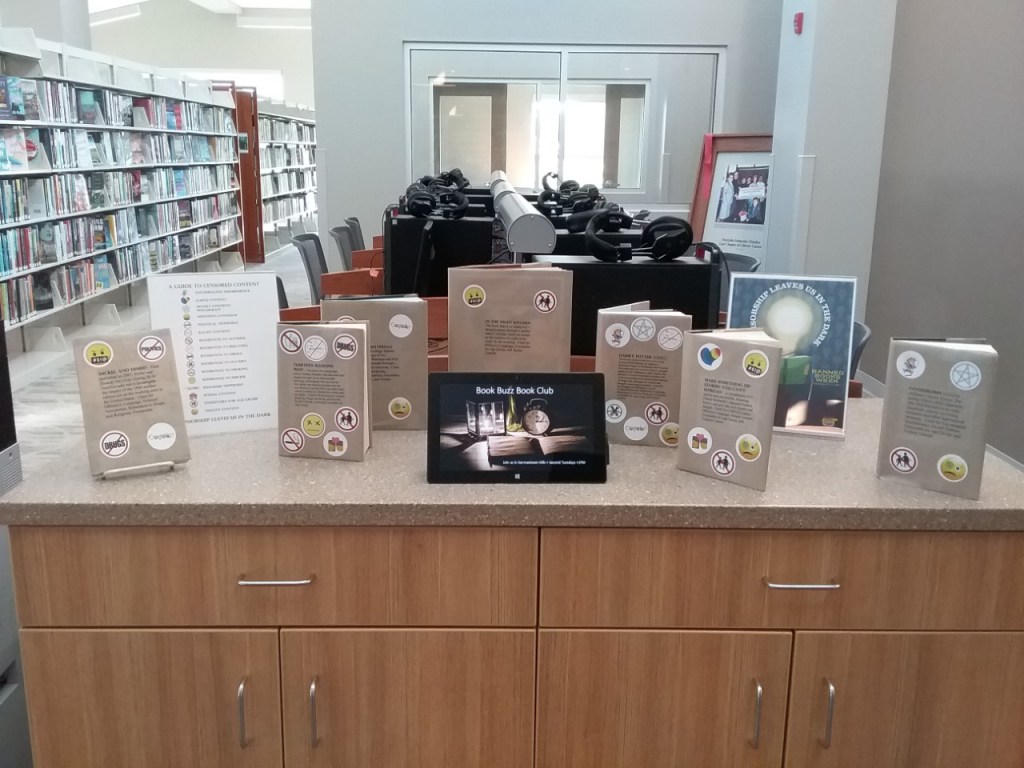
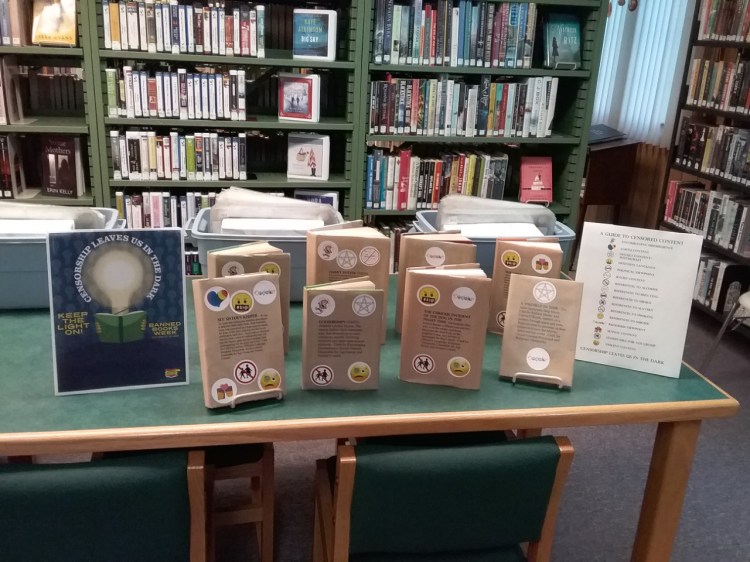
This brings us back to our desire to celebrate Banned Books Week.  Once again, I am working in a semi-rural library district, where some books just aren’t part of our catalog, but mostly due to space considerations and the availability of titles through inter-library loan from nearby, larger districts within our metropolitan area.  As I was going from branch to branch, wrapping books in brown paper and adding colorful emoji stickers to represent the reasons for each book’s challenges, I was greeted with a mixture of reactions, but almost all positive.  By displaying our “questionable” material in this manner, it highlighted the theme of the week and created a conversation starter for our librarians and patrons to discuss the problems related to censorship.  My favorite reaction came as I was wrapping a copy of Stephen King’s Cujo (offensive language, sexual content, and violent content).  The librarian became giddy and gleeful, declaring that she was happy to see “that book covered up.  I hate that cover, with the snarling mouth and dog fangs!  Can we keep the brown paper on it, even after Banned Books Week is over?”  She had nothing against the content, only the illustration on the front!

Whatever you do to celebrate Banned Books Week, make sure it is more than just, “Here are some controversial books.”  Make it a point to talk to your patrons, engage them on the topic of censorship and freedom of expression, and explain why it is so important to draw attention to challenged books.  You will not get everyone to agree with you on the topic of censorship or book banning, but you will learn more about who your patrons are, giving you greater insight in to how to balance on that tightrope between freedom of intellectual expression and alienation through offense.

Recent Teen Programming Successes

By Allison Riggs

How do I define a successful program?

This could be a whole post on its own, so I am just going to give a very short summary of how I define a successful program. Although still helpful and important, it’s not all about the numbers. I believe that what the patrons get out of the program is the most important thing, even if only three patrons show up. Did they have fun? Did they learn something new? Did they make a new friend? Did they learn an important life skill? If you can answer positively to any of these questions, you had a successful program. On the other hand, if you do similar programs over and over again with really low attendance, it may be time to try something new or try new ways to reach patrons. It is okay to admit when something isn’t working. We’ve all been there.

In today’s post, I want to share two successful teen programs I held over the summer. One of the things I truly value in our community is how wonderful librarians are at sharing their ideas, and I hope you can now add these to your own programming idea list. If you have any further questions about either of these programs please don’t hesitate to contact me and ask!

Nailed It – Summer Edition

Inspiration: Nailed It / Failed It: Holiday Snacks Edition By Kris Cram, Young Adult Specialist, Omaha (Neb.) Public Library

Quick Overview: Teens were tasked with recreating popular marshmallow pops I found on Pinterest just like the contestants on the popular Netflix show Nailed It. The new season aired in May 2019 and I held the program in June. The teens were given very minimal instructions and therefore had to get creative and problem solve on their own to try and recreate the summer themed marshmallow pops. I chose the Goldfish, Shark, and S’more marshmallow pops. They had one hour to create two of each pop. We had two microwaves so they could melt their chocolates; this step took the most amount of time. Not many teens finished all six pops, so one of each kind would have been enough. I had 15 teens attend this program. Some saved their creations to show their family and some ate them right away.

Sand Art Terrariums

Inspiration: Average But Inspired Blog

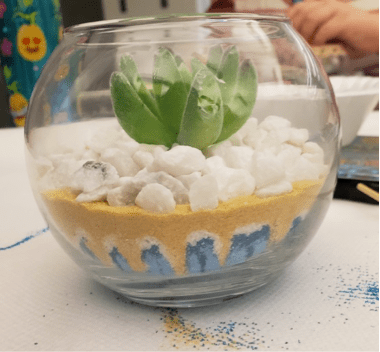
Quick Overview: Using Dollar Tree vases, colorful sand, plastic dinosaurs, paper straws, rocks, washi tape, and faux succulent plants, one can make a fun and affordable teen program. I gave the teens a few tips on how to keep their sand from mixing into a sad color along with different ways to make the sand designs. From there on out they needed very little help from me. I also always throw on some fun instrumental music of popular songs for background noise and some of the teens like to try and guess which song is playing. I had 17 teens attend this program, and they all said they had lots of fun! Here are a few terrariums the teens made. Each one was unique and used a variety of the supplies I gave  them.

Sand Art Terrarium – Allison Riggs

Pollution Prevention Week, Libraries, and Sustainability

By Laura Barnes

Pollution Prevention (P2) Week is celebrated each year during the third week of September. I wouldn’t be surprised if you haven’t heard of it. Although the concept of pollution prevention is familiar, the phrase itself isn’t widely used these days. P2, also called source reduction, is any practice that reduces, eliminates, or prevents pollution at the source. Reducing the amount of pollution produced means less waste to control, treat, or dispose of. It also means fewer hazards posed to public health and the environment.

What does P2 Week have to do with libraries? A lot, as it turns out. Pollution prevention is the cornerstone of sustainability. Earlier this year the ALA Council adopted sustainability as a core value of librarianship. In the announcement, ALA President Loida Garcia-Febo said, “By adding sustainability to its core values, ALA is recognizing that libraries of all types can act as catalysts and inspire future generations to reach solutions that are not only sensible but essential to sustaining life on this planet.”

The good news is that the library’s core services prevent pollution because they encourage people to borrow rather than buy. The Library of Things movement has expanded collections beyond books and movies to include seeds, American Girl dolls, prom dresses, interview clothes, tools, kitchenware, and art, among other things. Library computer labs are important community resources for those who don’t have internet access or a computer at home. Most people don’t think about these services as pollution prevention. It’s just what libraries do.

Libraries are trusted information sources within their communities. This gives them a lot of influence when it comes to fostering community sustainability. Some ways to leverage that influence to drive change are to:

  • Look at library operations through a prevention lens. Where can you improve energy efficiency, conserve water, or reduce the use of toxic chemicals? Can you use reusable tableware and decorations at events? Can you reduce your paper use? What happens to your computers when you upgrade your labs? What do you do with your weeded materials?
  • Use your building and operations practices as an educational tool. Tell your community what you’re doing, how much money you’re saving from making changes, and what you’re spending that money on instead.
  • Partner with community organizations to encourage pollution prevention in your community.
  • Develop programs with sustainability themes. Bring in speakers to help businesses in your community improve their environmental performance.

Over the next several months, I’ll be writing about ways that you can incorporate sustainability into your library’s operations and program content. If your library is already a community leader in sustainability, let me know what you’re doing. I’d love to share your story with the Illinois library community.